Safety Requirements
These guidelines are required for every foster and adopter. They exist to protect your dog in an unfamiliar environment — please read them carefully before your dog comes home.
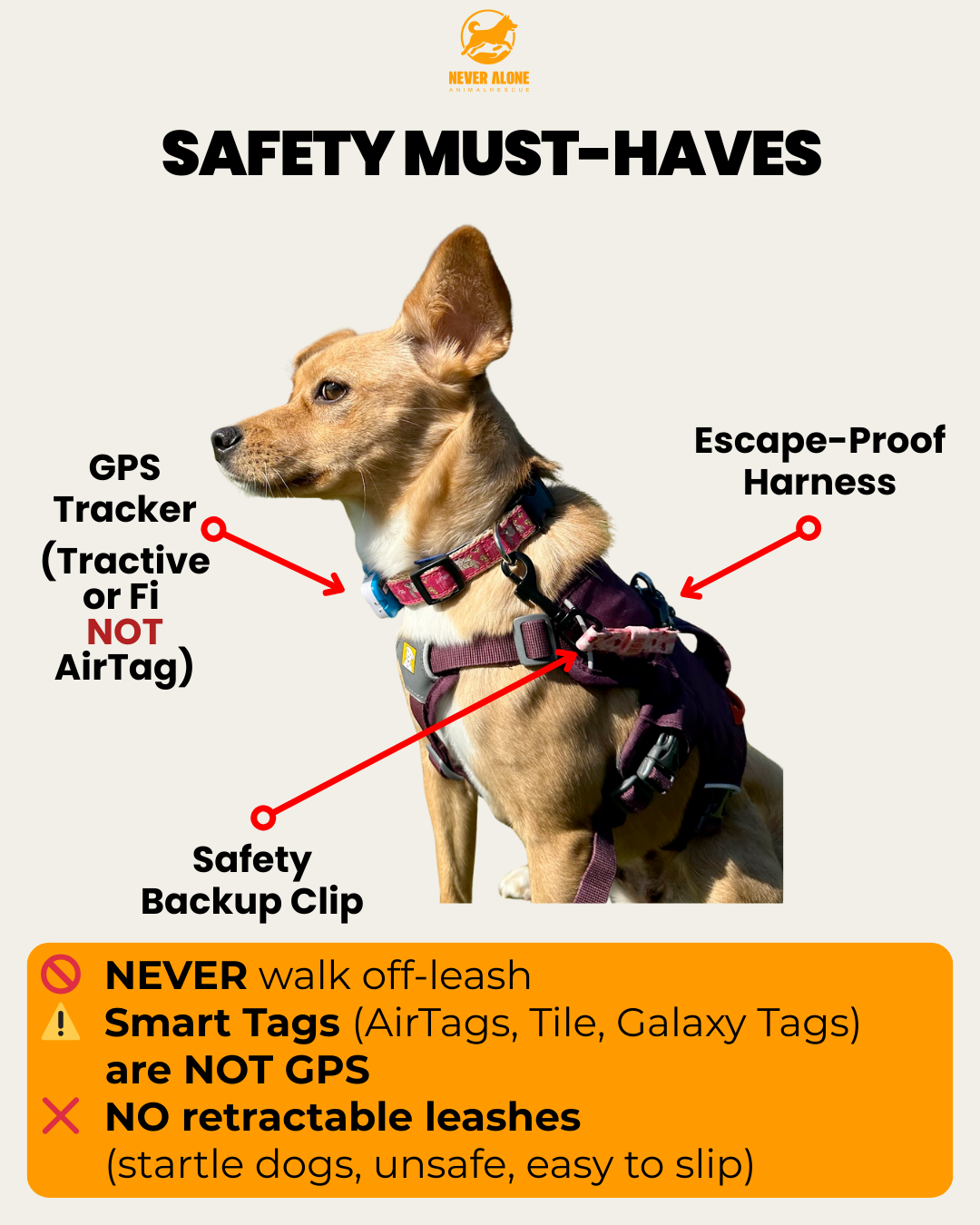
Essential Items
All items below must be in place before pickup. These are not optional.
Escape-Proof Harness Required
An escape-proof, back-clip harness is essential — rescue dogs can panic in new environments and slip out of standard harnesses. Recommended options: Ruffwear Webmaster Harness or the Hurtta Safeguard Harness ECO. Pair with a martingale collar worn separately.
GPS Tracker with Active Subscription Required
A real-time GPS tracker — not a smart tag — is required at all times. Choose either the Fi Smart Collar or a Tractive GPS Tracker, both with an active subscription. AirTags, Tile, Galaxy Tags, and other Bluetooth smart tags are not acceptable — they do not provide real-time location tracking.
Safety Backup Clip Required
A backup clip connects the harness and collar together at all times when your dog is outside. This single item prevents the most common escape scenario — a dog who panics and slips out of either the harness or collar alone cannot escape both when they are clipped together. Options: Amazon or Tags for Hope.
Leash Required
Use a sturdy, fixed-length leash with a carabiner-style clip — not a retractable leash. Retractable leashes startle dogs, are difficult to control, and make it easy for a dog to slip free.
Baby Gate at Front Door When Applicable
If your front door opens directly to the outside — a street, road, or building exit — a baby gate must be installed at the entry before your dog arrives. It creates a second barrier so that even if the door opens unexpectedly, the dog cannot bolt out. This is especially important during the first weeks when your dog is still adjusting to the home.
Never walk off-leash — even in enclosed areas, even if your dog seems calm and settled. Off-leash time is only appropriate after proper recall training has been completed. During the trial period or foster placement, off-leash is not permitted under any circumstances.
No retractable leashes — they startle dogs, are unsafe, and make it easy for a dog to slip free.
Smart tags are not GPS. AirTags, Tile, and Galaxy Tags use Bluetooth proximity — they cannot locate a lost dog in real time. Only Fi or Tractive with an active subscription satisfies the GPS requirement.
Rules for Every Situation
These guidelines apply to all fosters and adopters. They are especially important during the first few weeks, when your dog is adjusting to a new environment.
Keep your dog on a leash indoors
Always keep your dog on a lightweight 6-foot leash indoors during the adjustment period. This ensures safety and control without distressing the dog. The leash may be removed when all household members are present or during nighttime. Recommended options: PetSafe Nylon Dog Leash or Frisco Solid Nylon Dog Leash.
Be careful at the front door
If your front door opens directly to the outside — a street, road, or building exit — a baby gate must be installed at the entry. Be extremely careful when opening the front door, whether walking in or out or letting guests in. Even a well-settled dog may try to bolt unexpectedly. The baby gate creates a second barrier so the dog cannot reach the door directly.
Close all windows
Keep all windows closed for the first few weeks. After the adjustment period is over and there is no flight risk, always keep mosquito nets closed to prevent escape.
Collar, name tag, and GPS indoors
Your dog should always wear a collar with a name tag that includes your contact information, plus a GPS tracker — even inside the home.
Secure the leash before opening the door
Use a short leash and collar in the car. Take the loop end of the leash and leave it outside while closing the car door — this ensures you always have hold of the leash before the door opens, and prevents the dog from moving around the car.
Crate or seat belt as alternative
A travel crate or dog seat belt can also be used to prevent your dog from jumping out when a door is opened.
Full gear required
Your dog should wear a collar with name tag and GPS tracker, plus a second collar or harness with a 30-foot cotton leash attached. The safety backup clip connecting the harness and collar must be in place at all times.
Never leave unattended
Do not leave your dog unattended in the yard. Watch for digging near the fence — it can happen quickly.
Know your dog's triggers
Pay attention to what sounds or sights cause your dog to react. Avoid those triggers for the first few weeks. If your dog is reactive around other dogs, cross the street. If they are anxious around strangers, a yellow scarf signals to passersby not to approach.
If your dog gets scared
If your dog suddenly panics and tries to pull, go backward or sideways — do not pull toward you. Pulling can cause the collar to come off. Give as much slack as possible, move with the dog, and try to distract them. Always carry your dog's favorite treats.
Waist-worn leash
A waist-worn leash may be used for convenience but must always be secured with a backup clip.
Do not chase
Chasing a frightened dog causes them to run faster and further. Call your dog in a happy, calm voice using familiar phrases — "let's go home," "let's eat," "who's a good boy." Take steps back while calling them.
Do not approach directly
Even if your dog is moving toward you, do not move toward them. Keep stepping back until they are calm. You may need to do this all the way to your home, yard, or car.
Use treats and toys
Take out their favorite treat or toy and use it to lure them toward you. If they continue to run, follow at a safe distance and keep offering.
Secure calmly
Once your dog is calm and close, ask them to sit or lie down before reaching for the collar and attaching the leash.
Notify us immediately
If your dog escapes, contact Never Alone Animal Rescue International right away at 617-901-7097.
These guidelines exist in memory of Tania, a beloved dog we lost in April 2024. By following them, you help ensure that no other dog — or family — goes through the same loss.
Questions about any of these requirements?
Contact Us